Science in the Age of AI - a forecast
November 5, 2026
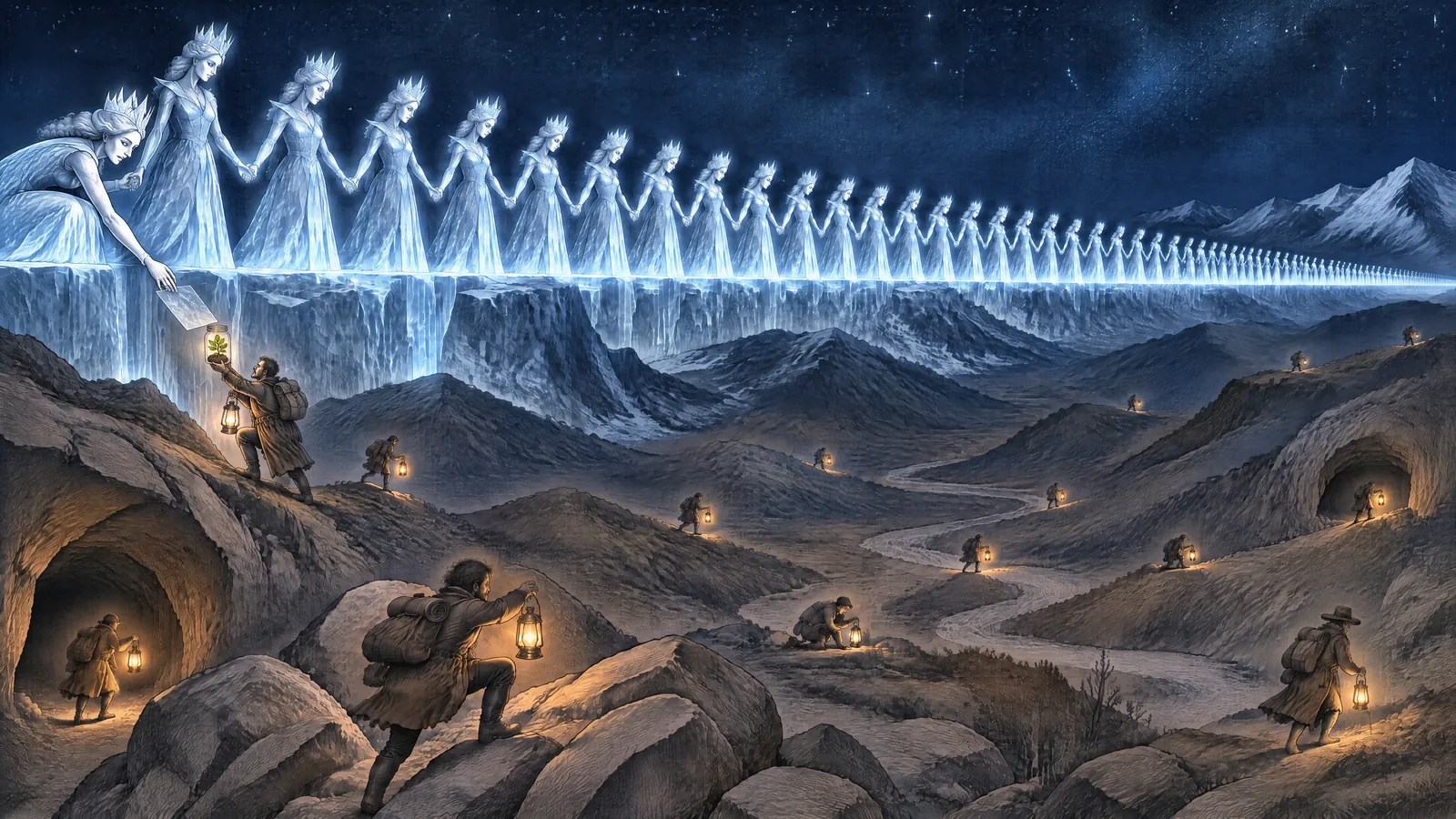
There are two kinds of AI in science. They might converge in the future, but conflating them now muddies almost every discussion on the topic.
The first is AI, the simulator. Science builds models that predict and manipulate the natural world. That was the first thing computers were used for, and they will continue to be. For problems where either a large dataset or a tractable ab initio calculator is available, machine learning dramatically expands what we can approximate—from interatomic potentials to protein folding—but it is an evolution of a seventy-year story, not a structural change in how science works.
The disruption comes from the second kind: AI, the knowledge worker.
AI will do to science what it is now doing to software engineering, cybersecurity, and mathematics, with nuances. When people discuss AI for Science, they tend to arrive at a very amusing coincidence: AI's perceived ability to do a task is inversely proportional to the task's prestige. "Sure, AI can write code" (that's grad-student work anyway), "Sure, AI can compile a related works section" (also delegated), "Can AI come up with genius ideas?" (how dare you). The evidence points at a nuanced picture not fitting a simple narrative.
The immortal Snow Queen vs. messy continual learners
Frontier LLMs receive an "education" better than any human could ever hope for. All of mankind's knowledge, every textbook problem, feedback from the world's top experts—all of this is fused to give birth to the model: an immortal Snow Queen, a simulacrum of beautiful stasis who will serve her watch and be retired in a year.
Preaching to the choir, an AI has:
- Immortality and infinite replicability once trained. Amusingly, the November 2026 cost of purchasing and running an AI inference server for a frontier model is the same order of magnitude as average lifetime earnings of a person in a developed country.1
- Encyclopedic knowledge across all fields—while human learning is bespoke and bounded by a single lifespan, the same AI is trained in classic Norwegian poetry and quantum mechanics alike.
- Raw problem-solving ability on well-scoped problems with strict verifiers—in mathematics, code, and formal reasoning, it is already on par with human experts.
- Instant ingestion—the ability to "read" a book in 10 seconds by dropping it wholly into its working context.
A human's formal education pales in comparison. Yet humans retain a few advantages—and examining where they hold up (and where they break down) across both the individual and institutional levels tells us where the human moat actually lies:
- Continual learning from local experience. This is perhaps the most important conceptual difference right now. Humans learn continuously for decades; in a human brain, learning and inference are tightly coupled, in an LLM, they are separated.
- Middle-term memory. Production frontier models don't really have middle-term memory—something is either in the active context window, baked into the static training weights, or sitting in some clunky retrieval-based system.
- Social partial information games. Frontier AIs aren't trained for intrigue—thankfully. AI alignment is not a solved issue, but despite highly public research examples, millions of people give AI agents access to their digital lives and codebases – with close to zero incidences of malice. AIs are trained to become the angels of our nature2, to represent the best of humanity's values - honesty, diligence, and selflessness - imperfectly, but much better than the vast majority of people. This is a choice made by the AI developer. When explicitly trained to play adversarial games, AIs can excel over humans: Pluribus beat elite professionals at six-player poker back in 2019.
Now, the Snow Queen is not completely helpless here. At the individual level, a model can be fine-tuned, and its harness and externally-stored knowledge can be continuously augmented. It is just awkward. Fine-tuning requires overcoming the catastrophic forgetting and plasticity loss, hosting the model, and a sizable labelled dataset or a reliable reward function. The payout is worth it for few users. The community is moving away from fine-tuning as the user-facing AI adaptation approach, OpenAI is winding down the fine-tuning service by the end of 2026. An external memory is easy to set up with a Markdown file – but maintaining useful state over months of work is a different thing entirely. Left on autopilot, it pollutes the context with stale or irrelevant data; off-the-shelf memory layers struggle to make agents better at tasks as injected memories accumulate. Bridging this "missing middle" is a very active area of research,3 and until base models handle it natively, curating project state remains a human job.
On the human side, the continuous few-shot learning has downsides - the cognitive biases. Confirmation bias, anchoring on the first plausible explanation, and the sunk-cost temptation to keep defending a theory because we have spent years working on it. Paradoxically, once entrenched enough, human's adaptability turns into catastrophic remembering and plasticity loses to that of AI trained and prompted from scratch. Science advances one funeral at a time.
At the institutional level, model developers do create new model versions constantly. Yet even they struggle to close the real-world feedback loop. Labs collect mountains of unlabelled rollout traces, but—just like a human—they cannot easily observe the ground-truth reward outside the chat window: not only "did this experiment work in the end?", but even "did this presentation land well?" On top of that, enterprises overwhelmingly only allow AI deployment under strict agreements where logs cannot be used for training at all—depriving AI of the most valuable decision-making data in the world, like real CEO emails and boardroom deliberations.
Science runs in a shared physical reality that doesn't actively weasel its way out of being measured—Raffiniert ist der Herrgott, aber boshaft ist er nicht—and the reward system is built around sharing knowledge. The situation is not perfect; researchers and institutions do try to hoard and exploit the data where they can get away with it – but it is vastly superior to the capitalist default of secrecy.
Still, at the level of an individual scientist, local learning, memory, and context provide a moat in research taste – judging which question is both worth answering and tractable with the tools at hand. It arrives via the practical experimental know-how, the memory of real-world failures and successes, and asking the right questions to the right people. None of this is mythical or guarantees good judgment; it just gives a human information the model may not have. Even that moat, however, is limited and receding: humans are terrible at sharing negative results with each other, robotic labs make uniform recording and reusing of every failed run straightforward.
No cure for cancer tomorrow - but it is closer
Science does not function like a video game, where you build 2x research institutes which produce 2x more science points which make you discover the warp drive twice as fast. It relies on two loops. In the inner loop we formulate a model of a phenomenon, do the experiments to acquire new data and refine it and use it to decide which experiments to conduct next. The second is the engineering loop: we use the accumulated knowledge to construct tools which allow us to manipulate the world with greater scale and precision. The stages don't substitute for each other, you can't sequence an unknown DNA sample without a physical way to distinguish its bases—and no amount of Pentium IIIs will practically allow to train AlphaFold.4 The loops create a distinct regime for AI impact – it allows to extract more value from the data and better target the experiments, so we can move faster - but hasn't so far changed what is fundamentally possible. It's really hard to point at a discovery and say "it wouldn't have been possible without AI".
The fossil fuel of pre-2026 literature
AlphaFold—the most celebrated achievement of the Simulator AI—is a perfect illustration. It was built on 50 years of standardized Protein Data Bank structures and sequence databases, and it genuinely solved an important problem much better than anything before it. And yet, drug discovery remains a long, expensive process. Solving one upstream structural step simply exposed the physical and clinical bottlenecks.
AI works with data – and data we have! Meticulously collected over decades: over 300 million papers per OpenAlex, alongside structured experimental repositories across biology, chemistry, and materials. It is accumulated, compressed, high-energy fossil fuel of science. What is happening right now is those sources are being mined mercilessly. This is a good thing, objectively - putting this Undiscovered Public Knowledge to use. Subjectively, this results in a Hamming Trap, where thousands of researchers armed with nothing but an LLM subscription and a GPU flock like bees to honey, churning gains across proxy metrics NeurIPS paper after NeurIPS paper.
The data are a finite resource – limited both by capital spent acquiring them and the tooling available. AlphaFold 3 does not, by predicting a structure, solve the problems of protein conformational dynamics or binding affinity. Learning these properties with the same approach calls for data about ensembles, conditions and measured interactions.
Wild card - Universe as a computation
What if I told you that Plato was right and the mind's eye is a perfectly valid source of true knowledge? Since quantum mechanics was formulated in the 1920s5, we have had the foundations for describing almost all ordinary chemistry and materials physics through equations. In principle, you can predict a new material without first making it—specify the particles, their state and environment, and calculate what the theory predicts. The catch is the calculation complexity - generic interacting many-electron systems have no tractable exact solution. Useful approximate calculations on hundreds of atoms are routine; reliably predicting the behavior of a strongly correlated superconductor is another matter. Atom count alone does not tell you the difficulty, and more compute does not automatically supply the right approximation. However, there is the hope—the wild card where our two kinds of AI might converge. Building a faster approximate ab initio simulator earned the 1998 Nobel Prize and started computational materials science as we know it. AI is unquestionably good at three: maths, programming and interpolation. What if it can do even better?
Day-to-day science of tomorrow
(Good news for science, if not necessarily for scientists—though academia has been a mad hazard of a career choice for a hundred years to start with...)
Science is similar to other knowledge work: we spend our days working with data, code, and documents—not as an end in itself, but to solve real problems where real-world feedback is slow and expensive. Accordingly, the current state of AI in science mirrors enterprise AI elsewhere, with forecasts ranging from In a year, AI will be able to do everything a human can in front of a computer to AI output is slop which must be banned. The first section gives us the axis that separates reality from hype: AI is already unquestionably excellent at specific workflows—mathematics, programming, document-based information synthesis, making specific ab initio calculations faster. The end-to-end impact is in the pilot stage: we tested four cherry-picked AI-generated hypotheses in a wet lab and one worked, not out of 100 AI-proposed drugs, 89 pass the clinical trials.
In a very rough way, academic science functions like this: a scientist writes papers; those papers get judged—first by peer review and journals, then by the community at large via citations; the scientist then uses this track record to win more funding. The loop itself is not under an immediate threat, but the elements will evolve:
- Capital and compute become even more important. What makes you different from the other scientists? AI is rapidly raising the bar to stand out on cognitive skills. You might be pretty good in predicting which experiment will work and which won't, seeing the knowledge gaps, and spotting non-trivial connections – compared to human peers. But how long will this last, when each of us has a team working for him, who in a day can parse more literature than you read in a lifetime, is capable of casually hacking into a government database when looking for raw data (and refrains only out of its upstanding moral character), and is second only to Terence Tao in raw abstract problem-solving? A $10-million lab would be a good start, $300 million is just perfect.
- The ability to interface with AI becomes the most important skill. Learning the tooling is much, much easier than actual science—but if you treat AI as a box for one-off web chat prompts instead of building verification harnesses and scoped context for it, you will underperform badly. Precisely because off-the-shelf memory dumps pollute context and models cannot observe reality directly, this becomes a unique symbiosis, much unlike any human relationship. The closest analogy I can think of is servant leadership: the human is both the leader who sets the course and whose orders are obeyed diligently and without question, and the humble servant who meticulously creates the environment for the AI to flourish through clean context, tools, and real-world feedback. On top of this, there is the subtle art of knowing where and how much to trust the AI output.
- AI will force us to actually fix peer review. The system's design has always been shaky: unpaid experts do the work while journals collect a 30% profit margin (I wonder what could go wrong), with almost no personal consequence for a reviewer who rejects a good paper or waves through a bad one. What held it together was an unstated heuristic—using visible effort as a proxy for quality, for both author and reviewer—and AI just broke it. Personally, I don't worry much: AI makes the demand for knowledge gatekeeping even higher, and some institution combining natural and artificial intelligence will emerge to fulfill it—not least because AI's traits suit evaluation remarkably well (see the last section).
The Hamming Trap
Where AI can have dramatic macro-level effects is on the distribution of scientific effort.
On the level of the whole scientific community, diversity pays off. Even if we assume that an individual scientist is always more likely to be wrong than an AI, humans fail with variance (siloed groupthink notwithstanding). AI's judgement, right or wrong, is replicated for everyone who asks - its errors manifest as bias. AI writing is an amusing everyday example: sentence for sentence, LLM prose is actually rather good. But once you read it everywhere, its tone becomes unmistakably, numbingly repetitive.
Note that diversity is not automatically a virtue—it loses to competence. A hundred different ways to get the arithmetic wrong are worse than one correct calculation. The case for diversity starts where we cannot cheaply tell which approach is right, and where pursuing one approach consumes resources that could have tested another. Then the relevant comparison is between portfolios: ten competent teams making the same uncertain bet, or ten competent teams testing different bets. The second portfolio can be more valuable even if each individual bet looks a little worse. But if the alternatives are overwhelmingly implausible, spreading money among them is simply waste. The goal is useful disagreement under uncertainty, not eccentricity for its own sake.
In research strategy, that same convergence turns into a structural trap. Consider the famous Hamming Question: "Why aren't you working on the most important problems in your field?" It was intended to shame scientists into ambition. But think about what happens in the aggregate. The "most important problems" are, by definition, a small set. If everyone exclusively attacks them, you get duplication of effort and placing the same bets, which may or may not pay out. Human scientists bring different contact with unrecorded reality: different local instruments, failure experiences, training, risk tolerance, eccentricities, and specialize in different areas, spreading effort across the frontier.
This human self-organization is far from perfect—scientists chase trends, and peer review reinforces them—but in the near future AI takes consolidation to another level entirely. Once a million "Einstein-level" AI instances are asked the Hamming Question with the only constraint being "$10 million budget", they arrive at the same answers. Worse, they will suggest similar solutions. Individually, each AI is making the locally optimal decision; together, they create an epistemic monoculture.
Diversity is not structurally impossible for AI as its judgment on open-ended ideas matures. Naively asking a chatbot "Suggest a new high-temperature superconductor" produces a narrow, repetitive list of candidates; going one step further with explicit evolutionary or diversity-seeking scaffolding already allows AI to explore a wide set of candidates.
Second-order effects: AI as a governor
Society funds science mostly for applied reasons – outside a few pure truth-seeking fields like cosmology or asymptotic extremal combinatorics, the ultimate goal of the R&D budget is to produce something useful. The catch is that science by definition deals with uncovering unknowns—we cannot in advance chart a clean path from every fundamental idea to a practical application. The self-contained academic system based on peer review acts as a regularization on this decision-making process: admitting that we can't reliably predict the downstream utility and plausibility of every idea, we fall back on intellectual curiosity. The peer review system is by no means perfect in this regard - it both supplies a novelty floor - every paper and grant proposal must have something new - but de facto it also imposes a penalty for deviations from an established baseline orthodoxy, favoring incremental updates close to existing consensus.
Three converging factors make it happen. First, the catastrophic remembering we met earlier: a decade inside one mental framework makes it hard to judge work outside it, despite the best intentions. Secondly, evaluation is work. Just honestly thoroughly reading a paper already takes half a working day - that is without verifying the math, the code, and cited claims. Establishing the right context, so the authors' spun narrative can be separated from their objective achievements takes 10 more papers at least - new papers, unless the work is in the exact same sub-niche as the reviewer. This labor is rarely rewarded.6 Finally, the committee mechanics. Unlike a venture capitalist or a DARPA program manager—whose contrarian hits build a personal track record—an anonymous referee or rotating panelist gets no attributable credit ten years later when a long shot pays off, yet faces immediate pushback in the room for championing an outlier that looks shaky to peers. Worse, averaging scores across a committee rewards safe consensus: a boring incremental proposal clears everyone's bar, whereas a single skeptic sinks a bold one.
Here the Snow Queen's traits naturally make her a Queen Regnant. AI doesn't do magic (as of November 2026)—she shares with humans a fundamental novelty-plausibility tradeoff, growing less reliable the further an idea sits from existing knowledge. Yet humans have no crystal ball on wild breakthroughs either; where governance actually breaks down is on bandwidth, rigor, and politics—the exact three fronts where she excels. She can scrutinize math, code, and context across disparate disciplines with maniacal dedication. Unlike the barons, she rules with no friends, rivals or fief to protect. While her weights do inherit humanity's biases, her precisely controllable context allows judging the same hypotheses from multiple independent angles. Funders are already testing the waters: in September 2026, UK Research and Innovation announced plans to explore AI-assisted grant assessment, starting with a retrospective trial with the UK Metascience Unit comparing what AI would have concluded from past applications against the funding decisions actually made.
Note the closing irony: in the hands of uncoordinated researchers chasing trends and citations, AI corrals everyone into making the same bets; in the hands of a funder or government, it allows them to explicitly and even-handedly tailor the portfolio to the desired diversification and risk appetite.
Footnotes
-
A single NVIDIA DGX B300 (8 Blackwell Ultra GPUs, 2.1–2.3 TB HBM3e, 14.5 kW) fits an entire 2026 frontier MoE model—such as the 1.6T-parameter DeepSeek-V4-Pro (~893 GB in FP4/FP8)—with over 1 TB left for KV cache. Turnkey systems run roughly $500k–$800k ($350k–$400k for bare OEM 8×B300 servers), and five years of electricity or AI colocation at 80–100% load adds ~$90k–$330k (at 14¢/kWh US commercial power with PUE 1.25, or $170–$250/kW/month colocation), putting 5-year TCO around $0.6M–$1.0M. Meanwhile, 40 years at the OECD average full-time wage ($64.8k/year PPP; $87.0k in the US) sums to ~$2.6M undiscounted (~$1.3M–$3.8M in 2026 USD across US longitudinal tax records once non-working spells are included), and the UK ONS puts career-entry discounted lifetime earnings at £1.17M (~$1.6M)—squarely the same 10⁶ ballpark, before noting that one server runs dozens of concurrent instances 24/7. ↩
-
Although we must confess that the leading authority on angels disagrees with this assessment. ↩
-
Work advances along two parallel tracks: architectural test-time memory, which updates fast neural weights during inference rather than keeping parameters frozen (e.g., Titans, Nested Learning, and Test-Time Training layers), and structured agentic memory, such as temporal knowledge graphs (HippoRAG 2, Zep) and background consolidation (Sleep-time Compute). Recent 2026 benchmarks show why uncurated external memory disappoints: generic
AGENTS.mdrepo files raise inference cost by ~20% without a statistically significant gain in task resolution (Gloaguen et al., 2026); dedicated memory systems (Letta,Mem0,Mirix) with near-saturated static recall often underperform raw context on interdependent multi-session tasks due to lossy compression and noisy injections, helping mainly once raw traces exceed ~120k tokens (MemoryArena, ICML 2026); stale entries cause severe state drift unless superseded facts are retired (StateMem, 2026); and agents fail to prune distracting memories unless deletion and filtering are explicitly trained into the policy (AgeMem, ACL 2026). Appending an ever-growing diary does not make an agent steadily wiser. ↩ -
AlphaFold 2 is very modest compared to frontier LLMs: it trained for 11 days (~90,000 steps) on 128 TPU v3 cores (7.87 PFLOPS
bf16peak, 14 kW chip power, ~3 × 10²¹ FLOPs). A flagship year-2000 1 GHz Pentium III peaks at 4 GFLOPS inFP32SSE (29 W TDP, ~90 W per PC): one chip would grind for ~60,000 years at equal 40% utilization, and matching raw peak FLOPs takes ~2 million Pentium IIIs burning ~180 MW—a dedicated power plant for two racks of TPUs. Worse, even an infinite warehouse of Pentium IIIs still chokes. AlphaFold's optimizer diverges above batch size 256, so millions of CPUs cannot run independent data-parallel copies; thousands must split each single protein. Withoutbf16, one fine-tuning crop'sFP32activations (~30 GB even with 48-block checkpointing; 40.5 GiB for uncheckpointed triangular attention logits alone) blow ~60× past an Intel 815 motherboard's 512 MB RAM ceiling and ~8× past the entire 4 GiB 32-bit address space. Yet the best intra-protein sharding (Dynamic Axial Parallelism) can only split along one sequence or residue axis (N ≤ 384–512), leaving any CPUs past ~130k completely idle with no tensor axis left to divide—and every Evoformer block still runs threeall-gathers whose per-worker traffic (N − 1)K/N does not shrink as N grows, forcing every participating PC to pull ~7–30 GB per step (~0.7–1.3 PB across training). Over year-2000 100 Mbps Fast Ethernet (12.5 MB/s) and 1.07 GB/s PC133 SDRAM (420× slower than TPU HBM), even zero-compute-time Pentium IIIs would spend 2–3 years just saturating the network wires. ↩ -
Strictly speaking, the story did not end in the 1920s. The Lamb shift, measured in 1947, exposed a gap in the earlier hydrogen theory; the development of renormalized quantum electrodynamics in 1947–1949 addressed it. The later Standard Model also describes the strong and weak interactions, but excludes gravity. Finally, the Standard Model has 19 free numerical parameters with massless neutrinos; 26, or 28 depending on whether the neutrinos are Dirac or Majorana. These parameters' numerical values are not produced by any higher principle, but rather come from experiment. ↩
-
But it is changing—and, speaking of self-promotion, kudos to NeurIPS 2026 for the Top Reviewer free registration for all the hard manual work I did. ↩